
This week we read Parashat ‘Kedoshim’, which is perhaps the beating heart of the entire Torah from a social and moral perspective. The portion opens with the famous commandment: “You shall be holy, for I am holy.”
When we think of the word ‘holiness’, especially while traveling here in Central America, it’s very easy to imagine a complete detachment from the world. Perhaps isolating oneself on a mountain peak, a few days of silence, or deep meditation in the jungle. In Puerto Viejo, it really is easy to disconnect. The freedom, the wild nature, and the distance from home allow us to shed all our daily obligations and pressures.
But the Torah comes to tell us the exact opposite. It explains that true holiness isn’t achieved when we run away from society, but precisely when we live within it.
The portion presents us with an amazing sequence of social and daily laws through which this holiness is achieved: It requires us to respect our elders with the commandment “You shall rise before the aged”, it forbids us from gossiping or holding a grudge, it demands that we maintain just weights and measures in the market, and requires that we not stand idly by when someone else is in trouble – “Do not stand idly by the blood of your neighbor”. It even explicitly commands us to love the stranger and the foreigner, simply because we too were strangers in the land of Egypt. And right there in the middle hides the most well-known rule in the Torah: “Love your neighbor as yourself”.
This portion comes to remind us that especially in a place like Puerto Viejo, where everything feels distant and liberated, our true test is in our relationship with the people around us. Holiness at BINA House is not a matter of religious rituals, but a communal and human matter.
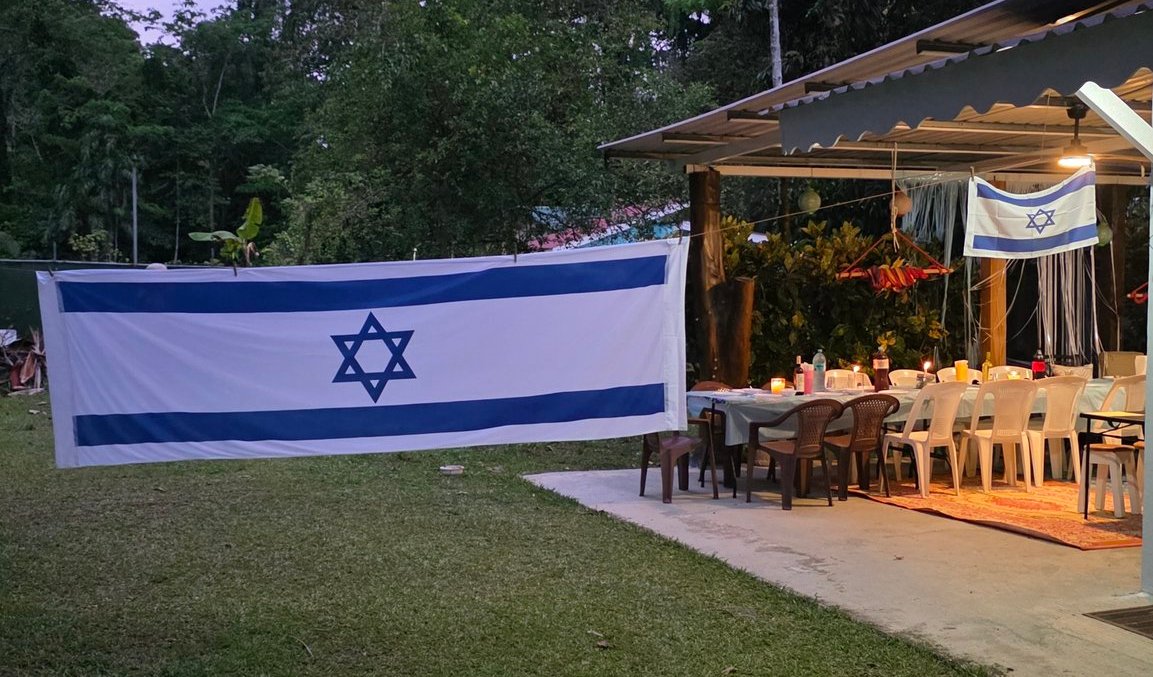
One of the most beautiful commandments in the portion is the law of ‘Pe’ah’ (the corner), where the Torah asks the farmer not to harvest his entire field, but to leave the edge – the Pe’ah – available for the poor and the stranger passing by on the road. For us, this ‘field’ is the Shabbat table we are sitting around right now. The meaning of leaving a Pe’ah today is that even when the table seems completely full to us, we will always know to squeeze the chairs a bit and leave an empty seat for another traveler who just got off the bus, with a backpack on their back, and doesn’t know anyone here.
And when the Torah says “Love your neighbor as yourself”, it talks about those moments when people arrive here exhausted from the road, sometimes carrying hardships from the journey or just homesickness. Our ability as a temporary community to embrace them, pour them a glass of water, truly listen to them, and be there for them at eye level – that is the true meaning of holiness.
Our holiness is found exactly in the human connections and the fabric we weave here tonight, thousands of kilometers from home.
So I wish for all of us that we continue to celebrate our freedom and the ‘Pura Vida’, that we take a moment for ourselves facing the waves, but that we always remember to sanctify the connections between us and leave room in our hearts (and at our table) for one more person.
Shabbat Shalom and Pura Vida!